
Innovation has been the key to attaining sustainable growth in public, private or non-profits sectors. Being on the creative side of an organization is to solve ever-increasing challenges due to shorter product life cycle and a continuous urge to innovate. Rapid change in technology and consumer perception increases demand for more flexible and relevant products and services. In classic approach, organizations depend on In-house R&D to utilize its existing human and capital resources, enabling innovative capabilities, developing proprietary technology, optimal control over technology & knowledge management.
Innovative Culture – Diffusion Strategy
Diffusion strategy for innovation depends on the capabilities of an organization in production, marketing, and Captial. ‘Innovative culture’, is key to organization aspiring to be on the creative side. It is wide, believed that the larger firms have an advantage in adapting to new technology based on access to resources. Often, this argument is incorrect as larger structure results in tough monitoring, difficulty in approximating incentives, less efficient to change. As a solution to this problem, organizations choose to create virtual organizations, Network organizations, and Modular organizations.This method also has flaws in redundancy in innovation due to loose collaborations.

Recent advances in perception towards innovation and increased capital and human resource demand led to the creation of multiple models of ‘collaboration’ to achieve the same goals (new product development) in short time possible. Over the years, collaborations evolved to become a very complex system influencing rights and obligations of each partner organization and mutual benefit. In many cases, it defined the direction of existing standards and perception.

Protecting Innovation
Innovation demands a larger share of risk for organization’s current account cash flows, protecting the exclusivity is crucial. especially, in the case of Joint Venture and Licencing, it requires the parent organization to maintain ‘Architectural control’ on Technology.
Processes in ‘Architectural control of technology’
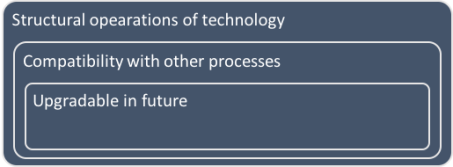
To keep Innovative culture through out the organization, Mechanistic structures were proven wrong, it leads to the creation of Organic structures enabling the free flow of ideas. For instance, ‘Bootlegging program’ gives employees with 15% of work time to dedicate to their own ideas and projects.
Funding Innovation
Because R&D relies on a cooperative and collaborative environment, it is difficult, if not impossible, for companies to differentially reward employees working side by side, even if one has a brilliant idea and the other doesn’t. In general, The venture model provides an engine for commercializing technologies that formerly lay dormant in corporations and in the halls of academia. For an instance, it is estimated that U.S. corporations spend $133 billion on R&D.
Failure for these companies typically, due to investing to protect existing market positions; they tend to fund only those ideas that are central to their strategies. The result is a reservoir of talent and new ideas, which creates the pool for new ventures.
The newest funding source for entrepreneurs is so-called ‘angels’, a group or individual experienced investors, contribute seed capital, advice, and support for businesses with a total contribution amounting to $20 billion to start-ups, a far greater amount than venture capitalists do.
Public policy and Legal framework in Innovation
Governments provide two incentives to develop and commercialize new technology.
The first is the patent and trademark system, which provides monopolies for inventive products in return for full disclosure of the technology. That, in turn, provides a base for future technology development.
The second is the direct funding of speculative projects that corporations and individuals can’t or won’t fund. Such seed funding is expected to create jobs and boosts the economy.
The majority of the innovation is still limited to educational institutions, where the R&D cash flows are majorly depended on the government policies. It is estimated that each year spending is close to $63 billion.
References:
- Harvard Business Review: https://hbr.org/1998/11/how-venture-capital-works
- Technology and Values by Shrader – Frechette & Westra
- Public Acceptance of new technologies – Roger William & Stephen Mills
- Strategic Mangement of Technology Innovation – Melissa A. Schilling
 In Human Hands
Leave a comment